
St Lawrence
From the Gospel according to St John, Except a corn of wheat fall into the ground and die, it abideth alone; but if die, it bringeth forth much fruit. (John, 12:24)
Today we celebrate the Feast of St Lawrence the Martyr, who died around the year 258. To begin things, let’s spend a little time learning something about him. Lawrence, was born in Valencia in present day Spain. While he was in Zaragoza, he met St Sixtus, who at that time was a famous teacher, from Greece. The two of them became friends, and traveled together to Rome. In 257, Sixtus was made Bishop of Rome, after which he ordained Laurence to the diaconate, and made him Archdeacon of Rome. Lawrence was placed in charge of the treasury of the church, and the distribution of alms, a very power position within the city.
A year later, Sixtus was arrested and executed, during the persecutions of the Emperor Valerian. After this the Roman authorities demanded that Lawrence turn over all church valuables to the state. Instead, we’re told by St Ambrose, that Lawrence sold off, or distributed, all the Church’s property, and gave the proceeds to the needy. When the prefect, Cornelius Saecularis, demanded the treasures of the church be given to him, Laurence brought him the poor, the crippled and the blind, informing him that these were the treasures of the church. As punishment for his actions, Lawrence was ordered to be roasted to death on a gridiron. Legend says that at a certain point during his torture, Lawrence asked his executioner to turn him over, telling them that he was done on that side.
He was buried in Rome, and his tomb is in the crypt of the Basilica of St Lawrence Outside the Walls. The gridiron that he was tortured on, is located in the Basilica of San Lorenzo, in Licina. After his martyrdom, Lawrence became a very important saint within the life of the Roman Church. He is often considered to be the third patron of Rome, after St Peter and St Paul.
To further demonstrate this importance, let me give you some other examples, regarding how the Church honored him. All of these examples are connected to the calendar of the Church, and how Lawrence ranked within it.First, yesterday we celebrated, or would have celebrated, the feast of Vigil of St Lawrence, a service on the eve of his heavenly birthday, a rare honor. Almost all other vigil masses are connected directly with Christ, St John the Baptist, the Blessed Virgin Mary or Apostles. The only other exception is the the well know vigil of All Saints, or Halloween. Also, Lawrence’s feast day at one time had what is called an octave. This meant that it was celebrated for the next seven days after the actual feast day.
In addition, the feast day of St Lawrence was once considered to be a Holy Day of Obligation. This meant the faithful would have been expected to attend Mass on this day, much like they would be expected to attend services for Easter, or Christmas. And finally, during the seventh century some church calendars measured the summer Sundays, not as Sunday’s after Pentecost, or Sundays after Trinity, but Sundays after major saints of the Church. In the instance of Lawrence, there would have been seven Sundays after the Feast of St Lawrence, after which came the Feast of St Michael.
There is one other event I wanted to bring up, though it’s not directly related to the Church calendar, The Perseid meteor showers, which take place yearly in mid August, were once known as “The tears of St Lawrence.”
Now let’s move on to today’s Gospel. In the Gospel we heard: “He that loveth his life shall lose it; and he that hateth his life in this world shall keep it unto life eternal.” St Augustine translates this out as: “Love not this present life, in such wise that thou be in jeopardy of losing life eternal. The words here are not intended to cause us to believe that we’re required to completely reject a life in the world. Instead, we are to avoid obsessing about our time in the world, to the exclusion of all else. While we’re living our lives, from start to finish, our priority should still be the events the world the come, or in other words, the Kingdom of Heaven.
Lawrence was an excellent example of this concept. He was only thirty two when he was made Archdeacon of Rome. As a young man, he certainly could have found other things to do in his life, if he had chosen to. But Sixtus obviously saw a reverential attitude within him, and gave him a post of great responsibility. And I would says that Lawrence surpassed his expectations.Based on what we find in the hagiographies of the saints, during this time period, the Roman civil authorities would wanted more than just the Church treasury. From their point of view, it would have been just as big a victory, to have a high ranking member of the Church apostatize from the faith.They likely would have rewarded Lawrence greatly, if he had simply turned the wealth over to them by choice. However he refused to give the authorities either of the things they truly desired. And by his refusal to give in, he was also able to use the moment as a teaching tool. He showed what is truly of value in the sight of God.
In many ways it could be said that Lawrence was a custodian, one who has been entrusted with certain things of immense worth. However these things were obviously not what the world had come to believe that they were.The true treasures of the Church are not money. They aren’t the buildings or churches, not matter how beautiful they are. They are people, those of the faithful who pray in God’s churches. The fact that Lawrence selected the poor, the crippled and the blind, was intended to be symbolic. They represent those who had flaws in the sight of the world, but have a very distinct value in the sight of God. We too are sinners, based on the faith, but we are have value in the sight of God.
Now having said that, as average parishioners, we may believe we will never be called to act like Lawrence did. We might feel that we won’t called to care for valuables of the church, whether they be large, or even small groups of people.However, like Lawrence we can still be considered to be custodians. However, in our cases, we are custodians over ourselves, and our own actions. There is a concept within the spiritual life, known as custody of the senses. This idea means that we should always be spiritually aware, of what we perceiving with all of our senses, at any given time.Let say we detect something that is contrary to the faith of God. We are then called upon to act accordingly, and to reject interacting with this contrary thing . For example, if we’re watching a movie with questionable content, we should turn it off. If it’s a book with unseemly material, we stop reading it. If there’s a comment on social media, which is obviously designed only to provoke argument, then we ignore it.
Lawrence gave away a treasury, in an effort to care for those he was responsible for. We must be willing to all make the efforts, to care for ourselves, and our spiritual wellbeing. We must be custodians of our souls. Let us therefore follow the example of St Lawrence, be aware of what needs to be done, and do it. Even when we feel we’ve done as much as we can, and we have no more to give, we should remember his example. This may simply be the time to turn over, we are only done on one side.
Our Church
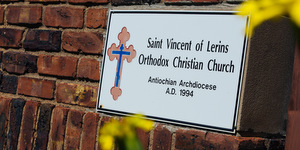
Please visit us for Orthodox worship within the Western tradition. Sunday Mass is at 10:00 a.m. We are also currently live-streaming Sunday Mass on the St Vincents Facebook page. You are welcome to join us there.
In addition we are offering low Mass and Vespers on Saturday, as well as Mass on Holy Days. To verify, please check the calendar, call (402) 551-9721 or email us at saintvol@yahoo.com.
St Vincent's offers the St Monica's Guild, our Antiochian Women's organization; a children's Sunday School, and our own St. Honoratus Bookstore.